
Rostov Air Base & Taganrog Drone Hub: Strategic Impact of Ukrainian Deep Strikes
A coordinated campaign of Ukrainian long-range strikes has delivered significant structural attrition across Russian military aviation and unmanned systems manufacturing in the Rostov region. Independent open-source intelligence (OSINT) assessments, supported by commercial satellite imagery, confirm high-value material losses at both Rostov-Central airfield and the Atlant Aero manufacturing facilities in Taganrog.
1. Aviation Losses at Rostov-Central Airfield
Satellite imagery verified by the OSINT monitoring group CyberBoroshno reveals direct hits against the parking aprons and dispersal areas of the Rostov-Central air base.
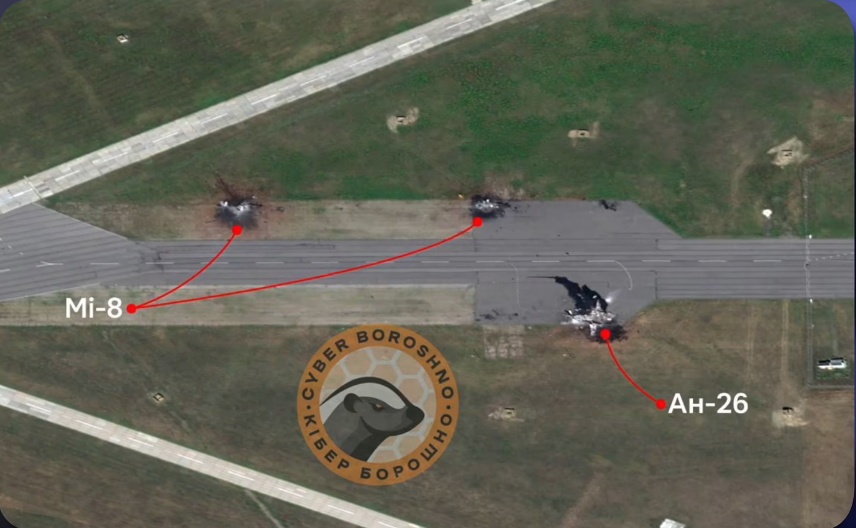 Figure 1: High-resolution satellite assessment showing burnt remains of two Mi-8 transport helicopters and one Antonov An-26 aircraft at Rostov-Central.
The confirmed losses include:
- Two Mil Mi-8 Helicopters: Completely incinerated on the apron, reducing local tactical rotary-wing transport and medical evacuation capacity.
- One Antonov An-26: Structural burn marks and airframe destruction confirmed along the taxiway.
- One Antonov An-12 Heavy Transport: Direct blast impact recorded on the flight line, eliminating a core logistical workhorse utilized for rapid military freight distribution.
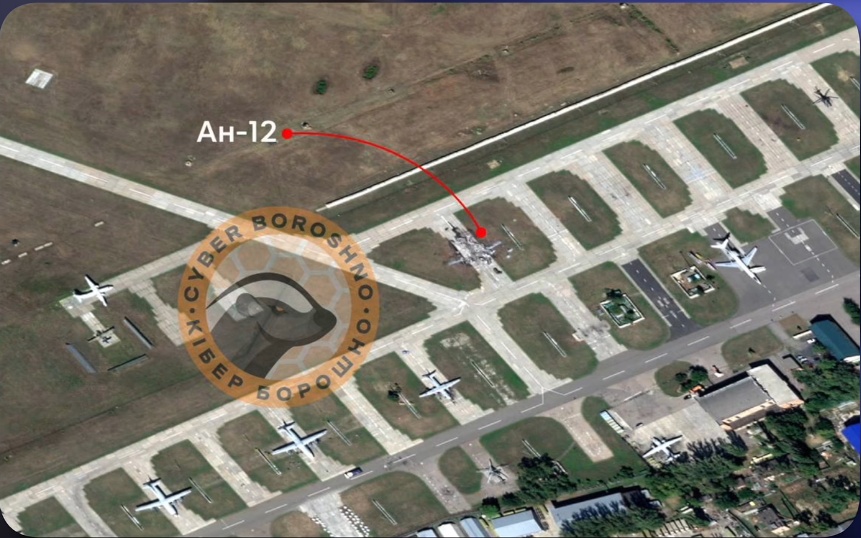 Figure 2: Satellite imagery capturing the direct impact footprint and destroyed airframe of an Antonov An-12 cargo aircraft.
Tactical transport airframes like the An-12 and An-26 are critical for maintaining supply lines between manufacturing bases in central Russia and forward operational hubs in the southern theater.
2. Precision Neptune Cruise Missile Strikes on Atlant Aero (Taganrog)
Simultaneously, strike elements—confirmed by operational reporting and OSINT community Exilenova+ to involve modified Ukrainian R-360 Neptune cruise missiles—targeted the industrial facilities of Atlant Aero in Taganrog.
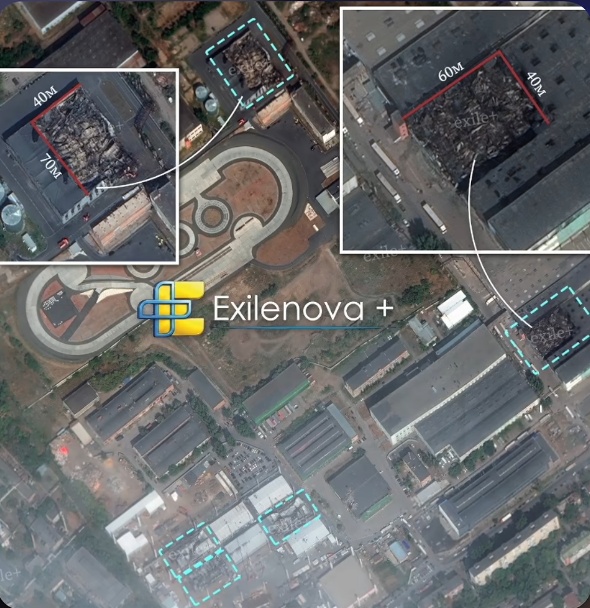 Figure 3: Satellite analysis displaying catastrophic roof collapses across assembly workshops measuring 60x40m and 70x40m at the Atlant Aero complex.
Atlant Aero, operating on grounds formerly tied to the TagAZ automotive plant, serves as a primary assembly and components production node for fixed-wing strike drones:
- Molniya-1 & Molniya-2 UAVs: High-speed, low-cost loitering munitions deployed in saturation attacks against Ukrainian logistical hubs.
- Orion Medium-Altitude Long-Endurance (MALE) Components: Specialized airframe sub-assemblies.
Successive strikes on September 12 and September 15 breached fortified industrial roofs, causing extensive internal fires that disrupted clean-room electronics assembly and specialized composite tooling.
3. Suppression of Ground-Based Air Defenses: S-400 Neutralization
The penetration of cruise missiles into heavily defended airspaces around Taganrog and Rostov was enabled by targeted suppression of enemy air defense (SEAD) operations.
 Figure 4: Geolocation analysis confirming the destruction of an S-400 surface-to-air missile system launcher operating in a dual surface-attack / air-defense role.
Geolocated footage confirmed the catastrophic destruction of an S-400 launcher unit. These systems have increasingly been dual-tasked by Russian forces—both for high-altitude air defense and reconfigured ballistic-trajectory surface strikes against inland infrastructure. The loss of these launchers creates localized radar and interception corridors that enable low-altitude cruise missiles to reach strategic rear targets unmolested.
Strategic Takeaways
- Supply Chain Disruption at Source: Rather than relying exclusively on frontline kinetic interception, Ukrainian targeting has pivoted toward neutralizing UAV manufacturing capacity (Atlant Aero) before airframes reach active units.
- Rear-Area Logistics Vulnerability: The destruction of multiple fixed-wing transport aircraft (An-12 and An-26) at Rostov-Central degrades regional turnaround times for military cargo and high-priority maintenance spares.
- Layered SEAD Success: The confirmed degradation of S-400 batteries highlights expanding gaps in regional integrated air defense coverage across the Sea of Azov littoral.